Showing posts with label Nilantha Ilangamuwa. Show all posts

Thursday, March 31, 2016

Cuba: The Communist toddler without parents ( An Interview )

Nilantha Ilangamuwa


( March 30, 2016, Serbia, Sri Lanka Guardian) With President Obama’s historic visit, the Communist island of Cuba is back in the world headlines. Politically unique since its 1959 revolution, Nilantha Ilangamuwa of Sri Lanka Guardian, spoke with one of its many exiles, Olivia Solis, a Cuban currently living in Serbia.

Here is an excerpt of the interview;

Nilantha Ilangamuwa (NI): You were born and raised in Cuba. What are your childhood memories of the social-political situation in the country?

Olivia Solis (OS): Nothing about Cuba is black and white. Taking sides always brings conflict. It takes time and wisdom to understand the scope of the situation. Being outside the country, you can compare to other societies where basic rights have been secured.

The Castros’ are old now, too old to dictate anything, and is time for a big change. Cuban society is strangled by false promises, excuses, tired of waiting and hopelessness. The youth of today are nothing like mine who still had something to relate to.


My childhood was fine, I think. We were poor but I went to school everyday, everyone was considered as equals, my parents had a paying job. Some children had more and some had less, but less here means near to nothing — no toys, no shoes to wear to school — and more means that you have had family members abroad who were able to send you some money or were a part of the military oligarchy and relatives of “war heroes”. The military still control almost everything on the island. In my case we basically lived off our relatives in the USA. The 1990s were the hardest period for Cuban society after the disintegration of USSR.

NI:  You were born in post-revolution era. How communist is Cuba now?

OS: Well I grew up with the idea of a little island but with huge pride, that everyone in the world paid attention to us. They make sure you are aware of this, and teach in constantly in schools. In every kindergarten, hospital, school, state-owned job (100% of jobs are from the state) you would see photos of Fidel Castro, Che Guevara, Camilo Cienfuegos, even Raul rarely.
I was born in the mid-80s so I remember very little. Cuba was a communist paradise, everyone had the same furniture,  same food on the table,  same shirts and shoes, you were able to pay for holidays and life was as good as it can be. If you kept your own ideas quiet everything seemed functional and perfect. My parents had this perception of a perfect society and then there was the breakup of the USSR and you realised how weak the Cuban economy really was, how the system never managed to sustain itself or its people, how there was no backup plan.
NI:  Do you consider Cuba’s Revolution a success story?
OS: The Cuban Revolution failed the Cuban nation. The propaganda of the Cuban revolution sounds very good to the ears of any leftist pseudo-Communist idealist: free education, free health care and tons of advances in the field, equality between women and men. The price for everything is hunger, oppression, poverty. I’m not being dramatic, I know there are many countries worse off and I shouldn’t be comparing Cuba with Sweden, not in a million years. But the lack of basic rights and the death of the civil society… the idea of thriving, not just surviving, and being able build your own path, or even just fix the roof of your house is something crucial in any society. I learned a lot when I got out. Human rights is considered a very sensitive topic because it is the language of the dissents, and the revolution should not be questioned in these terms. You should not question it at all, better talk low — maybe your neighbour works for the political police — that was how I grew up: be quiet, don’t question out loud. In the end you shut up, adapt or leave the country.
NI:  Tell us your story. Why did you leave Cuba?
OS: So I left, I’m married and have a child living in eastern Europe. I wasn’t obsessed by leaving, like many people I knew. There were two kinds of people, those who wanted to leave whenever possible, and those who were comfortable with the idea of the revolution and supported its inner values while compromising their conscience.
NI:  It said the former leader of Cuba, Fidel Castro, is the prime target for foreign intelligence agencies.  The CIA have reportedly tried to assassinate Castro over five hundred times. This is an amazing story. What is your take on this?
OS: I think there is other side of the story as well. Pride has been planted in me since childhood. Propaganda is very violent and sources of information in Cuba are censored when it comes to the “attempts” you mention.
For myself, as for many others, it was very disrespectful how Raul did not wait for Obama at the airport. Are we still playing a game to see who is toughest? Raul is supposed to represent the nation, not his own ideology. The Cold War is over. Great for Castro that he survived those assassination attempts, but this is all part of the myth. With time you realise that there are no untouchable icons, no unreachable leaders, no inhuman presidents.
Olivia Solis ( Photo - special arrangement )
Olivia Solis ( Photo – special arrangement )
NI:  You mention the Obama visit. As the first US President visiting Cuba since 1928, does this matter? If so, why?
OS: Cuba needs hope. The economy should flourish, people should have better opportunities and be able to build their own paths and not only focus on putting food on the table. Cuban people should be able to plan, build, grow. Havana is literally falling to pieces…. it is heartbreaking. If the USA is willing to make any progress for the better, they must be welcome.
Everyone should listen to the speech President Obama gave. I wasn’t sure about his position, I always thought he was maybe too charismatic, like a weapon for gaining people favours.  But this was perfect.
NI:  In an unprecedented joint news conference by both leaders they went head to head on human rights and economic sanctions. President Raul Castro gave chilling answers about political prisoners and other sensitive subjects. How did you perceive this?
OS: Well it was a disaster. It appeared staged, Raul did not listen to the questions. He coughed when issues such as political prisoners and human rights were on the table. Raul doesn’t know how to answer to these social issues. A list of political prisoners exists. These prisoners were abused with violence. Some of them died in jail and some through hunger strikes.
NI:  President Obama talked about Human Rights and Universal norms of humanity. Yet Guantanamo Bay Prison is located in Cuba. This hypocrisy has been seized on by the Cuban authorities. What is your take?
OS: The Cuban people should not suffer out of politics and policies regarding issues such as the Guantanamo Bay Prison. Cubans are always reminded of these matters but I think it is also wise to look around, above, under, not just backwards. Politicians cannot play hide and seek — showing Guantanamo or other US hypocrisies — while the ordinary citizens in the country are suffering.


Wednesday, March 30, 2016

Exclusive Interview: CIA does more harm than good in global politics

Nilantha Ilangamuwa

Talk to Sri Lanka Guardian John Kiriakou


( February 26, 2016, Hong Kong SAR, Sri Lanka Guardian) John Kiriakou, a retired CIA ( the Central Intelligence Agency) agent who has been in prison for nearly two years after blowing the whistle on the George W. Bush administration’s torture program. He sat with Nilantha Ilangamuwa of the Sri Lanka Guardian for an exclusive interview to discuss his life experiences as a former CIA analyst and case officer, yesterday, February 25th, 2016.
Here are some excerpts of the interview:
Nilantha Ilangamuwa ( NI): I assume this is very the first interview that you have decided to give to the Asian press so I’m glad that you have agreed to talk with theSri Lanka Guardian about the situation you have gone through and share your views on certain issues of domestic and foreign policies of the United States of America with us.
Was it a childhood dream to become a spy?
John Kiriakou (JK): Actually, yes. I was fascinated by the Iran hostage crisis of 1979-1981 and I decided that I wanted either to be a spy or to join the State Department’s Foreign Service. I was fascinated by international affairs.
NI: When was first-time you heard about the CIA and what was your first impression?
JK: The first time I had ever heard of the CIA was in 1975. My parents took my brother, sister, and me to visit my grandparents. When we got to the house, my grandfather asked, “Did you see that terrorists killed the top CIA man in Athens?” That was Revolutionary Organization 17 November’s first assassination. It was of CIA station chief Richard Welch, a crime that remained unsolved until 2002 and to which I devoted a good portion of my career.
NI: Reports say that your professor, who was himself a CIA official, motivated you to join the agency. Tell me more about this interesting part of the story?
JK: Yes, my professor was looking for graduate students whom he thought would be a good fit in the CIA. He pulled me aside and asked if I was interested. I said that I was, and he scheduled a long series......

Read Full Here;
http://www.slguardian.org/2016/02/exclusive-interview-cia-does-more-harm-than-good-in-global-politics/ 

An Interview with Paul Craig Roberts

Nilantha Ilangamuwa

Talk to Sri Lanka Guardian Paul Craig Roberts


( March 24, 2016, Washington DC, Sri Lanka Guardian) Paul Craig Roberts, former US Assistant Secretary of the Treasury for Economic Policy, talks to the Sri Lanka Guardianabout supply-side economics, US foreign policy, the Obama administration, the dangers of TPP, the Sri Lankan economy and the upcoming US election
Here are some excerpts of the interview:
Nilantha Ilangamuwa (NI): Dr. Roberts, Welcome to the Sri Lanka Guardian. You were United States Assistant Secretary of the Treasury for Economic Policy under President Reagan in the early 1980s. This was the time that neo-liberal economic policies began to dominate the world market. You yourself were awarded the US Treasury’s Meritorious Service Award for “outstanding contributions to the formulation of United States economic policy. But your recent analyses express strong opposition to these policies, in which you played a leading role in developing. May we have your take on this?
Paul Craig Roberts (PCR): The Reagan administration introduced supply-side economics as a new policy in order to cure stagflation, the simultaneous rise of inflation and unemployment. Supply-side economics is not neoliberal economics. Supply-side economics corrected one of the many mistakes made by neoliberal economics. As a high official in Reagan’s government, I was under constant attack by neoliberal economists who opposed Reagan’s economic policy. The supply-side policy that I introduced cured the stagflation, and the US economy resumed growing without having to pay for the growth in rising rates of inflation.
Today the successful supply-side policy has been abandoned.  Policymakers at the Federal Reserve (the central bank) and at the US Treasury have returned to the failed neoliberal policy. They say that they are trying to restart inflation in order to revive the economy.  In other words, policymakers have returned to the neoliberal view that economic growth requires the stimulus of inflation.

Read Full Here; 
http://www.slguardian.org/2016/03/an-interview-with-paul-craig-roberts/ 

Friday, March 18, 2016

Sri Lanka: Gota’s War or Fonseka’s War and the difference is……….

Nilantha Ilangamuwa

For Minister Field Marshal Sarath Fonseka, it is his time to prove that he is different from his foes. It is time to act like a politician, not like a tool of a politician before the gloomy weather of uncertainty creates the storm.

by Nilantha Ilangamuwa
( March 18, 2016, Colombo, Sri Lanka Guardian) If we listen to each party we learn that there are very interesting stories on the horror that this country was able to close no longer than seven years ago. However, history is written by the winners. “Theory becomes infinitely more difficult as soon as it touches the realm of moral values,” Carl Clausewitz, noted in his book, On War.

The crystal ball is in Fonseka’s hands, and he deserves it. When Field Marshal Sarath Fonseka signed the Memorandum of Understanding with the United National Front headed by the Prime Minister Ranil Wickramasinghe, many believed that he would be appointed to be in charge of defence related matters. But the greater expectation turned down out to be something different to the political climate. Time will tell us the Prime Minister Wickramasinghe killed two birds with one stone.
Field Marshal Sarath Fonseka right from the very beginning as a minister started talking about defence related issues, perhaps he is unearthing what he believes to be the many issues that people in Sri Lanka must know.
Minister Fonseka is exercising his rights but hardly sees the differences from those who opposed him and put him behind bars. His target is none other than but those who hurt him. And those who hurt him are none other than the Rajapaksas.
Indeed, it seems like Fonseka is taking the time to strategise the political tricks. However, perhaps he is blindfolded by his own historical contribution to this nation. He may be thinking people have forgotten or discredited what he did.  This is why he keeps on repeating himself. This could lead possible disadvantages to his political life.
However, there are mighty issues in his maiden speech in Parliament as a Minister, as well as the firing revelations during the press conference yesterday ( March 17, 2016) where he demanded the release of the LTTE suspect who supports the suicide bomber targeted him. The political life is slowly but surely coming out from the military top brass who was insulted and sidelined by then the “master”.  But, it may be interesting to know how many Field Marshals have become the Ministers in the world history. 
However, personalising the greater victory against the rebellion which exercised the most dangerous tactics such as human bombs and targeting unarmed civilians is not only unfair but it gives a bad taste to the truth. Even seven years after the war, the habitual motivation of blaming and shaming has not ended but is getting worse. No one can claim the victory of the war was a one man show, but it was indeed a collaboration of every community in the country.
There were thousands of Tamils and Muslims killed by the LTTE. Hundreds of Tamils and Muslims were fought against the LTTE. This must be credited and discussed in detail among the general public. There will be no reconciliations without truth. The truth is none other than but truth. When truth prevails, then the peace will be strengthened.
There is no doubt Field Marshal Sarath Fonseka has a story to tell. Also, there is no doubt that the former Defence Secretary, Mr. Gotabaya Rajapaksa was greedy in claiming all the credit and manipulating the truth to gain personal advantages.
One of the accounts, Gota’s War, contained somewhat interesting facts but distorted the whole meaning by giving the mawkish title to promote the personality. No one may have thought about promoting personality in order to take greater responsibility.  Adhishtana, a book written by Former Naval Chief Admiral ( Rtd.) Wasantha Karannagoda has used better strategies than the book “by” Gotabaya. So, the missing links of the whole drama are very much clear.  
For Minister Field Marshal Sarath Fonseka, it is his time to prove that he is different from his foes. It is time to act like a politician, not like a tool of a politician before the gloomy weather of uncertainty creates the storm. It would be sad if a despicable situation erupts by Field Marshal Fonseka continuation of Fonseka’s War in an effort to replace the Gota’s War.
Time to act differently, Mr. Minister Field Marshal Sarath Fonseka!

Saturday, January 30, 2016

Curbing corruption : DEAL OR NO-DEAL

Nilantha Ilangamuwa
by Nilantha Ilangamuwa

Every media is currently occupied with the anti-corruption tamasha of the newly elected government. We, as the citizens, should be entitled to enjoy true freedom. But we are only eligible to pay out of our hard earned pennies for tax. Nevertheless, we would be even more proud, if actions by our leaders eventually result in the culprits, who plundered public assets, being brought to book sooner rather than later.

Unfortunately, we have a balance report: neither high hope nor no hope on this highly media-oriented anti-bribery and anti-corruption operation. Media merely talks without proper action and this will lead us nowhere. At least that is what we have been taught by history. We are not attempting to pull down the holy policies of honest politicians (if we have such a category), but rather need to be reminded of the history of this nation.

Here is the brief judicial history of the curbing of bribery and corruption in this country;

“Bribery was an offence punishable under the Penal Code (of Sri Lanka) as far back as 1883. It was during the British rule that bribery was introduced as a criminal offence into the Statute Book. In 1954 the Bribery Act was enacted to contain bribery in the Public Service. In 1958 the Bribery Commissioner’s Department was established by the Act No.40, under the Ministry of Justice. In 1994 the Act no.19 created the Commission to Investigate Allegations of Bribery or Corruption. The first Commission commenced activities on 15th December, 1994.” (quoted- official website of the Commission to Investigate Allegations of Bribery or Corruption – www.ciaboc.gov.lk – accessed on October 30, 2015)

Bribery and corruption in public service

Just six years after we gained independence from Great Britain, we have drawn up the act to curb bribery and corruption in the public service. This could possibly be one of the oldest in the region. Apparently, Sri Lanka was one of few countries that maintained the moral authority of having a good administrative service (public service) at the time. Then, all the way down to early 1994, the country slipped backward, and anti-corrupt public service turned into the one of most corrupted failed services on the planet.

Where are the missing links? The most complicated but urgent question to be answered, perhaps. There is no point of engaging in the old game of blaming and shaming. But the hardest thing is to understand the depth of the problem and come up with a concrete political plan to establish anti-bribery and anti-corruption as the core policy of each political party, the government and non-governmental entities.

Curbing bribery and corruption is based on accountably and transparency. Accountability and transparency are personal questions which rely on the each persons’ conscience. This could lead any community to establish authentic anti-corruption mechanism. When this happens it becomes not only law but also a part of the culture.

If his assistants or stooges are corrupt, any leader dreaming to achieve a nation without corruption is a farce. Many politicians, who introduced flourishing ideas in their manifestos to curb bribery and corruption, have failed. They had to compromise with those who did not agree to their ideals. Deal or no deal is a political question which most of politicians across the globe have to engage in. Curbing bribery and corruption is an essential homework of our politicians and bureaucrats.

Commission to Investigate Allegations of Bribery or Corruption

However, our prayers go out to the leaders who have wisdom to consolidate power and engage in an authentic mechanism to eliminate bribery and corruption in the nation. In fact there is no doubt, bribery and corruption are the core symptoms of the cunning culture of governance.

In addition to the Commission to Investigate Allegations of Bribery or Corruption, the new government has established two new entities to curb this vicious practices; the Presidential Commission of Inquiry to Investigate and Inquire into Serious Acts of Fraud, Corruption and Abuse of Power, State Resources and Privileges (PRECIFAC), and the Police Financial Crimes Investigations Division (FCID) are the new babies of the anti-corruption mechanism of this government. The people are eager to make their complaints.

Dilrukshi Dias Wickramasinghe, the Director General of the Bribery Commission, disclosed to the media that since January this year the commission received more than 3,200 complaints - over ten complaints a day.

Not only the former President Rajapaksa, his brothers, and wife but also his colleagues, from his driver to the actresses are listed for investigations. It is indeed a positive indication, but what about those corrupted varmint wolves who maintain their disguise as meek sheep in order to allign themselves with the government?

It indeed sad to learn that former President Mahinda Rajapaksa is capable of obtaining all the information gathered by those two entities mentioned above, even before they launch an investigation into any complaint. It gives us the size of the loopholes.

Who is the watchers’ watcher?

Who is protecting the elephant in the room?

Isn’t it showing the other side of the story?

So, deal or no deal?

Originally published at Daily News and Sri Lanka Guardian 

Sunday, August 23, 2015

Parliamentary Polls 2015: What does it mean to us?

Nilantha Ilangamuwa
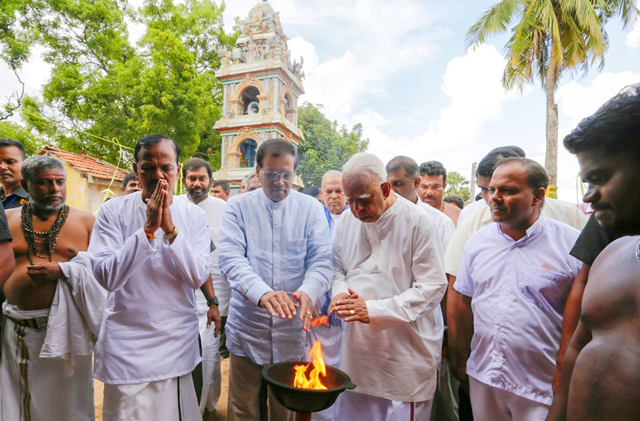
A ceremony was held under the patronage of President Maithripala Sirisena to hand over the land deeds to 234 war displaced families in Sampur, yesterday (22).

It is time for those who celebrate killing as the victory to understand the real causes behind the symptoms.

by Nilantha Ilangamuwa
( August 23, 2015, Colombo, Sri Lanka Guardian) An argumentative, free thinking and free speaking political culture, buried for decades is once again sprouting with good hopes and dreams in Sri Lanka. Such trends will construct space for healthy social discourse which can, hopefully, re-engineer the nation.
Seize the opportunity is the matter of common sense for the public and those who are privileged, as it was prescribed by Thomas Pain in his account centuries ago. This is what meant to us after two elections conducted this year in Sri Lanka. Despair replaced with hope, nightmares with dreams.
Years of conflicts and annihilation of the intelligentsia from the social system patched the way to grim and despicable repression. One of hardest questions we are facing now is how to diagnose the situation in order to understand the real problem when everything was distorted by political vulgarism and the crooked culture of opportunists.
This visible and painful challenge is now making its way out. It is up to the public who’s yet to understand the power of the powerless as it was examined and explained in his sage thoughts by Vaclav Havel in his context decades ago.
Of course this is all thanks to the former President Mahinda Rajapaksa for taking greedy, niggardly and highly irascible decisions when he had absolute power to control the Island nation till 2017. Hopefully his political career is on the down turn but sadly, as a Member of the Parliament he still persists. He is now on the edge in which he has to decide either side, scheming for grabbing the power or being confessional on his woebegone history before the true friends in the party.
However the result clearly indicates that the can of worms which was operated by Rajapaksa is still active. It has power and the “wisdom” to grab the larger number of votes within the Sinhalese community. It can be used for viciousness such as fuelling racial elements or reducing the dream of good governance based on conventionalism.
What would be the outcome when the common person has the liberty to think and cast their votes in a free and fair election? That is the most important question compel before us. Why did the majority of the voters in a particular electoral district think that the best man to govern them over the next five years is a man who is in remand for murder? What is the tendency behind electing a person who is doing everything, but nothing to do with politics? This anthropological scenario can’t be an accident but a deep rooted nightmare in the culture. It should be a major concern in a public discourse.
However, the memorandum of understanding signed between the United National Front and the Sri Lanka Freedom Party to form a national government is indeed a wise political idea to move forward and prevent political chaos. This is a historical political cohabitation which will benefit the country if it addresses the core issues behind the failure of this nation.
It is time for those who did an ‘exceptional’ job in the cause of getting rid of an internal civil war, to think and learn how to live in peace. It is time for those who celebrate killing as the victory to understand the real causes behind the symptoms.
It is only then that our long term dream of conventional politics will be achieved.

Saturday, November 22, 2014

Maithripala Sirisena: An Excellent Choice

Nilantha Ilangamuwa


by Nilantha Ilangamuwa

“O, let my land be a land where Liberty
Is crowned with no false patriotic wreath,
But opportunity is real, and life is free,
Equality is in the air we breathe.”
( Let America Be America Again – by Langston Hughes )

( November 22, 2014, Colombo, Sri Lanka Guardian) The 48-day-game has started. The ruling tyrant is in a dilemma because the common alliance has refreshed itself with new faces and new hopes.
The tragedy that is Rajapaksa is approaching its endgame. The coming election is his last attempt at survival, therefore he will not hesitate to use every dastardly and underhanded trick at his disposal to retain his power.  
This is one of the most significant events in Sri Lankan politics in recent history. At the same time this will be the last opportunity for the natural law gifted to the country to re-engineer the nation and correct its woebegone history. It is an opportunity for every citizen in this nation to play his or her part to achieve the ultimate goal, the restoration of integrity, dignity and humanity.
“Let Sri Lanka be Sri Lanka again.” 
Rajapaksa the tragedy, has proved its degree of internal illness by showing his emotional behaviour moments after the historical announcement made by the general secretary of the ruling party, the Sri Lanka Freedom Party ( SLFP). The general secretary Maithripala Sirisena, a civil servant turned politician, declared his acceptance of being the common candidate from the opposition alliance in the forthcoming presidential election which is scheduled to be held on January 8, 2015.
For the first time in the history of Sri Lanka, the two major political parties, the United National Party ( UNP) and the SLFP have come together under one umbrella to fight against a deteriorated political culture, it’s present architect and his clan.
While responding the situation the incumbent has shown his illiterate loquaciousness. His drunken political vulgarism compared the general secretary of the SLFP with the wife of the opposition leader just because they both have similar names. This is the real tragic face of Rajapaksa, the man who claimed to be the liberator and the protector of the nation. But in reality he is nothing but a plunderer of public resources and eliminator of the basics rights of the citizen in this country.
However the time has arrived. The line has been drawn in the sand and a new dawn promises the nation great hope.
The tyrant and his clan will have to find a way out. He can be choose the way of Marcos of the Philippines or Ben Ali of Tunisia.  Perhaps there is possibility that the Idi Amin Dada story will be repeated in the Sri Lankan context. It is all depends on how this golden opportunity is manage and articulated by the alliance and their capacity to convince the public.  
However, the opposition has made the correct and comparatively genuine choice. Their choice has every quality necessary to vanguish the disrespectful and nepotistic political culture in Sri Lanka. This is an excellent choice. This is the time for every right thinking individual who wishes to maintain and protect their political dignity to come out and join hands with their long term colleague and the party’s general secretary. This is not a one man game but the work of a team. Each decision taken by the team will rewrite the  history of Sri Lanka.
Why is Maithri an excellent choice? He is a politician with conscience and common sense. He is a politician who can take people out onto the streets. He is a politician who knows the real face of the tragedy that is Rajapaksa. He is a politician who can break the ruling alliance and re-establish the SLFP. He is a politician who can break the silence and unveil the deception of the public.
The game ahead; and the alliance will have to face all kind of challenges. But at last the bell will awake the public and lead to a new dawn of political culture in Sri Lanka.
Let Sri Lanka be Sri Lanka again. 

Thursday, May 22, 2014

Sri Lanka: Shaggy Dog Recommendations

Nilantha Ilangamuwa


by Nilantha Ilangamuwa 

 ( April 28, 2014, Colombo, Sri Lanka Guardian) Apparently, at least one so called "rational intellectual" the country produced thinks that by sending former army general, Sarath Fonseka, perhaps the best army commander in the world and the former President Chandrika Bandaranaike, to parliament that the regime will be able to justify their political vulgarism during the last decade. Perhaps he is seeing an in-depth relationship between the regime and Fonseka – Chandrika as being a panacea. In terms of political ridicule this is not only a shaggy-dog theory but also a dangerous evaluation of the reality of politics in this crucial time. This is not what we need in this hour of need.


Saturday, December 21, 2013

When freedom replaced “patriotism”

Nilantha Ilangamuwa
| by Nilantha Ilangamuwa

( December 1, 2013, Colombo, Sri Lanka Guardian) The truth has been placed before us that the passing of laws does not mean people will benefit from them without proper implementation through the criminal justice system in the particular country. In the words of the great poet Rabindranath Tagore, “facts are many, but the truth is one.”


Thursday, July 25, 2013

C.V. Vigneswaran - The new pop star

Nilantha Ilangamuwa
| by Nilantha Ilangamuwa

( July 25, 2013, Colombo, Sri Lanka Guardian) Let us remove the mask and without them let us look at the people who live on this rough soil. Where are we? What we are? Who has left us with nothing of value? Despair and hopelessness has been a part of our daily lives through the heritage of anger and stress due to rude, senseless, lawless, unjust power. One after another, time and time again the same thing in different modes is repeated over the years. 

Sunday, June 23, 2013

He Left Us – A Tribute to B. Raman

Nilantha Ilangamuwa

The departure of the spy master who articulated meaningful debate on security in modern media
| by Nilantha Ilangamuwa
(June 18, 2013, New Delhi, Sri Lanka Guardian) News came bit late, but it is confirmed! He left us! He never remained silent! At times he was frustrating! He expressed his anger in words many times! He opposed violence! At times he was eager to earn a nationalistic image even at his retired stage. He impressed those he came across promoting nationalism. His happiness seemed to go into hiding somewhere in the ladder of life but his face always appeared before us in a deep thoughtful mood. He is an icon of personal liberty! As a writer, he never influenced anyone to change their position or view point but always attempted to express himself clearly.

Friday, March 8, 2013

Sri Lanka: a Brainless Head

Nilantha Ilangamuwa
by NILANTHA ILANGAMUWA
“Nothing’s ever gone too far. Anything can be reversed; these are human decisions.”
– Noam Chomsky (An interview with the Al Jazeera- Jan 12 )
Colombo, Sri Lanka.

President Rajapaksa does what he wishes to do. Nothing to be surprised of, that is who he is.  He impeached the Chief Justice saying that the law was so dear to him and that he was a humble follower of the law in this respectful country. Accordingly,  he says that he followed the procedure as per  the constitution. Now he has installed another subject to the forcibly vacated seat which we call the seat of the “Chief Justice”. One of his brothers who is also a key player of this panoply of nepotism of the barbaric raj claimed this as an aspect of “check and balance”. But as happened  in many other cases, he misused the power obtained through the constitution, yet again. This is likely to  be repeated by him to get rid of political obstacles he would face in the future as well. How can you predict the strength of a building which appears to be beautiful and strong but is structurally outworn, unless you see the inside? You will never comprehend through your bird’s eye view how the power beast misused by the present ruling family cleared the way for the Chinese to make  roads and wetland parks throughout the country.

Saturday, August 11, 2012

Truth and Myth in Sri Lanka

Nilantha Ilangamuwa
Where Democracy is a Fiction

by NILANTHA ILANGAMUWA
Writes for the Counter Punch

Colombo, Sri Lanka.

Yet another prisoner died whilst in custody at Vavuniya prison in Sri Lanka this week. Sadly the death happened in the same day when a meeting organised by the Secretary Defence and Minister of External Affairs was underway at the national capital. It was reported that 42 delegates from various countries participated in the meeting. Mr. Mariyadas Pevis Delrukshan (34) from Paithakur, Jaffna was accused of being an LTTE supporter. He had been in the hospital after he reportedly sustained serious injuries during his term in custody. In this backdrop, and of several other pressing needs the country must be addressing like health, education and food security, one wonders what is the purpose of meetings like the one hosted at Colombo concerning national security.

Wednesday, July 11, 2012

Sri Lanka: Political Rein

Nilantha Ilangamuwa
Nilantha Ilangamuwa
Courtesy: www.scoop.co.nz  

The power of a community depends not only upon its numbers and its economic resources and its technical capacity, but also upon its beliefs. (Bertrand Russell – Power – P. 99)

The problem is not rising from outside but rather from within themselves. As long as the world about them does not change, the regime will remain content with their way of life and indeed, feel superior to other people around them as they can ignore them. The trouble is that the world is changing as it happened in the past. This ironically points to the need that we all have to understand, not only what the regime is doing, but also what other organizations are doing as well. However, the present regime is still able to manage the ground situation in the country while continuing their vulgarism as political ideology. Under these circumstances, the regime is still lucky to enjoy their ultimate power.


Monday, July 9, 2012

SRI LANKA: The role of journalists on preventing torture

Nilantha Ilangamuwa
Full text of the speech delivered by Nilantha Ilangamuwa at the event jointly organised by the Asian Human Rights Commission and the University of Hong Kong on Freedom of Expression and torture prevention at the Foreign Correspondent's Club (FCC), Hong Kong. June 25, 2012

Photo by Suluck Lamubol
Understanding the role of journalists on preventing torture and protection of human rights in a suppressed society
Question: - Where is Prageeth Eknaligoda?
Answer: - Our current information is that Mr. Eknaligoda has taken refuge in a foreign country.
Place: The UN Committee against Torture (UNCAT), Geneva, November 2011

Question: - Where is Prageeth Eknaligoda?
Answer: - I don't know if he is alive or dead, only god would know if the information that I received about him is true. I don't think even the government knows where he lives.
Place: The Homagama (Colombo suburb) magistrates' court, June 2012

(Answers given on two different occasions, by Mr. Mohan Peiris, Former Attorney General of Sri Lanka, currently a legal adviser to President Rajapaksa, for an identical question).


Sri Lanka: Charades and Its Price

Nilantha Ilangamuwa
The Victims Are From All Communities

by NILANTHA ILANGAMUWA
Courtesy: Counter Punch

Only a fool tests the depth of the water with both feet.

- African proverb

Columbo, Sri Lanka.

The entire country, not just its diplomatic missions, is in a dilemma today. This has its roots beyond the present regime’s misuse of authority. Absolute authority it did attain, since the Big Ben alarm sounded three years ago after winning the coldblooded war against the LTTE. Since then the government has spared no opportunity to make a drama out of every tragedy. The LTTE and the daily war that the country and its people fought are tragedies. Celebrating such a misfortune is also a tragedy. Perhaps the only people who do not know this are those who devour absolute power in Colombo. Or are they orchestrating a celebration out of everything to hide their stupidity?


Friday, December 23, 2011

නටත් රජෙක් සුරා මතින්

Nilantha Ilangamuwa
ජනරාල් ෆොන්සේකාට එරෙහි මාස තිහක සිරදඬුවම: පුද්ගලානුරුපයෙන් තොරව සන්සිදිය තේරුම් ගැනීම

නමුත් රාජපක්ෂ හිතන තරම් මෙම තීන්දුවෙන් හෙතමට යහපතක් වන්නේ නැත. එය ඔහු ස්ථීර සතුරෙකු නිර්මාණය කර ගැනීමකි. සතුරා යනු ජනරාල් නැමති පුද්ගලයා නොවේ. එනම් ජනරාල් නමැති සන්සිද්දියයි. එනම් ජනරාල් ෆොන්සේකා නමැති පුද්ගලයාට වඩා ජනරාල් නමැති සංසිද්දිය වඩා පෘතුල දෙයකි. එහි වෙනස තවත් වසර කිහිපයකින් මුළු රටටම දැනෙනු ඇත. දැන් මෙය රාජපක්ෂගේ මානසික තත්වය සමඟ විමසා බැලීම වැදගත් වේ.

නිලන්ත ඉලංගමුව

නාධිපති රාජපක්ෂ එක්සත් ජාතීන්ගේ සමුළුවට සහභාගි වී රටේ නැති යහපාලනයක් ගැන කතා කළද තමා සිතු පිළිගැනීම වෙනුවට සිදුවුයේ කොන් වීමටය. ඉන් හටගත් කේන්තිය මුදා හැරියේ ජනරාල් ෆොන්සේකාගෙනි. ජනරාල් ෆොන්සේකාට, "හමුදා අධිකරණය" මඟින් ලබා දුන් තීන්දුවට අනුමැතිය ලබා දෙමින් ඔහු මාස තිහක සිර දඬුවමකට යටත් කළේය. මෙම තීන්දුවේ එකම අරමුණ ජනරාල්ගේ කට වැසිමය. එය කළ හැක්කේ ඔහුගේ පාර්ලිමේන්තු ආසනය අහිමි කිරීමෙනි. රාජපක්ෂට විරුද්ධව, ගම් මට්ටමේ ජනතාව හැකි ඉක්මනින් වෙනස් කළ හැකි පුද්ගලයා වන්නේ ජනරාල් ෆොන්සේකාය. ජනරාල් ෆොන්සේකා නොහිටියේනම් රාජපක්ෂ දැනට නටන නාඩකමටත් වඩා දෙයක් මේ වන විට නටා අවසන්ය. අපේක්ෂා කළ පරිදිම ජනරාල් හිරේ දැමීමට රාජපක්ෂගේ සිංහල අන්තවාදී බමුණු මනස තීරණය කළේය. නමුත් රාජපක්ෂ හිතන තරම් මෙම තීන්දුවෙන් හෙතමට යහපතක් වන්නේ නැත. එය ඔහු ස්ථීර සතුරෙකු නිර්මාණය කර ගැනීමකි. සතුරා යනු ජනරාල් නැමති පුද්ගලයා නොවේ. එනම් ජනරාල් නමැති සන්සිද්දියයි. එනම් ජනරාල් ෆොන්සේකා නමැති පුද්ගලයාට වඩා ජනරාල් නමැති සංසිද්දිය වඩා පෘතුල දෙයකි. එහි වෙනස තවත් වසර කිහිපයකින් මුළු රටටම දැනෙනු ඇත. දැන් මෙය රාජපක්ෂගේ මානසික තත්වය සමඟ විමසා බැලීම වැදගත් වේ.


Libyans of the NTC: You are Modern Stupid Barbarians

Nilantha Ilangamuwa
by Nilantha Ilangamuwa

"....What is valued in war is victory, not prolonged operations. And the general who understands how to employ troops is the minister of the people's fate and arbiter of the nation's destiny.." ( The Art Of War - Sun Tzu )

You, Libyan members or sympathizers of the National Transitional Council (NTC) have done what Americans wanted. You did what your own people don’t want to hear at all. You stupid guys have danced to the tune of foreigners. The damage will cost your next generation in coming years. Of course, People of Libya needed serious change of regime but not the way you did it. You have thus become the prime example of modern stupid barbarism which kills its own people to roll out the red carpet for known evil. You demonstrated ignorance that a known devil is better than an unknown angel.


What will Obama have for Sri Lanka?

Nilantha Ilangamuwa
by Nilantha Ilangamuwa
(The views expressed are his own)

Sri Lanka is under siege after the introduction of the 18th Amendment to the Constitution which dissolved term limits of the President who, by an earlier constitution, is above the law and can now dispense with the independence commissions for free & fair elections, corruption control, police and government services which was introduced by the 17th Amendment.

The current President has abused the mannerly political culture in Sri Lanka far more than any previous leader has done. He has done away with all the norms of basic principles for good governance while taking the country into his custody. Now the country is dancing to the music played by the Rajapakse regime; like a puppy following its tail.


UNSG Playing His Fiddle To A Deaf Elephant – Analysis

Nilantha Ilangamuwa
By Nilantha Ilangamuwa

There is much talk about Accountability these days – at UN level. Where was this Accountability problem when more than 60,000 Sinhalese youth disappeared and killed by the Sinhalese leadership just three decades ago? So now the United Nations came up with the report which is called “Darusman Report”, with lots of errors and is asking for credible investigation on Sri Lanka.


Many of us find this amusing and we see someone laughing. Who? – None other than the person who has hoarded more political power than most politicians of our current times – “His Excellency President Mahinda Rajapakse”.